Hidden Costs When Buying Property in Kerala: A Complete Buyer’s Guide
Hidden Costs When Buying Property in Kerala: A Complete Buyer’s Guide Buying a property in Kerala—whether it is a flat, villa, house, or plot—is one of the biggest financial decisions most people make. Most buyers focus on the property price, loan eligibility, location, and amenities. However, the actual amount you…
Hidden Costs When Buying Property in Kerala: A Complete Buyer’s Guide
Buying a property in Kerala—whether it is a flat, villa, house, or plot—is one of the biggest financial decisions most people make. Most buyers focus on the property price, loan eligibility, location, and amenities. However, the actual amount you spend can be considerably higher than the advertised sale price.
The reason is simple: buying a property involves several additional expenses that may not always be included in the quoted price.
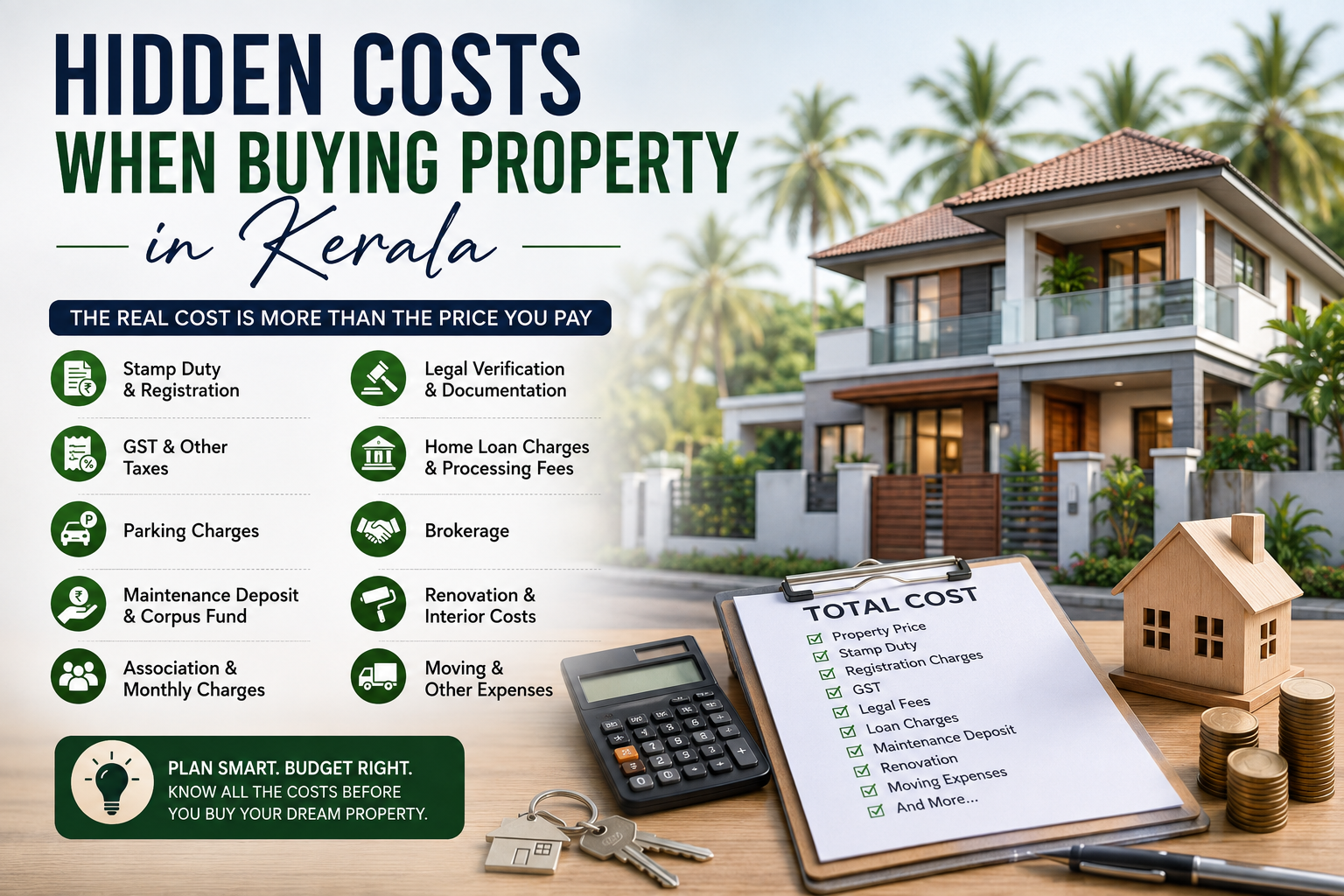
These costs can include stamp duty, registration charges, GST, legal fees, documentation expenses, loan-related charges, brokerage, maintenance deposits, parking charges, society charges, renovation costs, property tax, and other miscellaneous expenses.
Understanding these costs before making an offer can help you prepare a realistic budget and avoid unpleasant financial surprises at the time of registration or possession.
This guide explains the major hidden and additional costs that property buyers in Kerala should consider before purchasing a property.
________________________________________
1. The Advertised Property Price Is Not the Final Cost
One of the most common mistakes buyers make is assuming:
Property Price = Total Purchase Cost
In reality:
Total Purchase Cost = Property Price + Government Charges + Transaction Costs + Property-Specific Expenses + Financing Costs + Initial Setup Expenses
For example, if you purchase a flat for ₹75 lakh, your actual expenditure may be significantly higher after adding registration-related expenses, legal verification, loan charges, maintenance deposits, parking, interiors, moving expenses and other costs.
Therefore, when comparing properties, it is better to compare the total acquisition cost, rather than simply comparing the advertised selling price.
________________________________________
2. Stamp Duty
Stamp duty is one of the major government-related expenses when purchasing property in Kerala.
It is payable on the property transaction and is generally calculated based on the applicable value used for registration, subject to the rules applicable to the transaction.
For buyers, this can represent a substantial amount because it is calculated as a percentage rather than a small fixed fee.
Before finalising a property, buyers should confirm the applicable stamp duty with the Kerala Registration Department or a qualified property professional because rates and rules can change.
Kerala Registration Department
Why buyers should calculate it early
Suppose a buyer has saved enough money for the property down payment but has not kept additional funds for stamp duty and registration.
The buyer may suddenly need a significant additional amount immediately before registration.
This is why government charges should be included in your budget from the beginning.
________________________________________
3. Registration Charges
Stamp duty and registration charges are different.
The registration charge is paid for officially registering the transaction and recording the transfer of the property.
Many first-time buyers concentrate only on the sale consideration and discover the registration expense later.
When planning your purchase, calculate:
• Property consideration
• Stamp duty
• Registration charges
• Other applicable government fees
These expenses should be considered before deciding how much cash you can comfortably spend on the property.
________________________________________
4. GST on New Properties
GST can be an important consideration when purchasing a new property from a developer.
However, GST treatment depends on the nature and stage of the property transaction. For example, an under-construction property may have different GST implications compared with a completed property where the relevant completion/occupancy conditions have been satisfied.
This is particularly important when comparing:
New flat vs resale flat
A buyer may see two apartments with similar selling prices, but the tax treatment may make the total acquisition cost different.
Therefore, before booking a new flat, ask the builder for a complete cost sheet showing:
• Basic sale price
• GST, if applicable
• Parking charges
• Maintenance deposit
• Corpus fund
• Clubhouse charges
• Legal/documentation charges
• Other applicable charges
Never make a decision based only on the advertised base price.
________________________________________
5. Parking Charges
Parking is another expense that buyers sometimes overlook.
In some projects, the quoted apartment price may not include certain parking-related charges or additional parking requirements.
Ask specifically:
“Is the parking included in the quoted price?”
Also check:
• Number of allotted parking spaces
• Covered or open parking
• Visitor parking
• Additional parking availability
• Parking maintenance charges
• EV charging facility and associated costs
For larger apartments and premium projects, parking-related expenses can become significant.
________________________________________
6. Maintenance Deposit and Corpus Fund
New apartment projects commonly have expenses related to maintenance and common facilities.
These may include:
• Maintenance advance
• Corpus fund
• Sinking fund
• Association charges
• Common-area maintenance
• Facility charges
• Clubhouse-related charges
The amount varies considerably from project to project.
A buyer should ask for the complete possession cost sheet before making the final payment.
Don't assume that the apartment's selling price covers everything required before possession.
________________________________________
7. Apartment Association Charges
After purchasing an apartment, you become responsible for recurring common-area expenses.
Depending on the project, these can include:
• Security
• Lift maintenance
• Cleaning
• Generator maintenance
• Landscaping
• Swimming pool maintenance
• Gym maintenance
• Common electricity
• Water-related expenses
• Waste management
• Building maintenance
These costs may be charged monthly, quarterly, or annually.
A property with a lower purchase price but very high monthly maintenance may not always be the cheapest property in the long run.
________________________________________
8. Legal Verification Costs
Buying property without proper legal verification can be a costly mistake.
Before purchasing a house, villa, flat, or land, it is advisable to verify the relevant documents.
Depending on the property, this may include:
• Title deed
• Previous title documents
• Encumbrance Certificate
• Tax receipts
• Possession certificate
• Building-related approvals
• Approved plan
• Completion certificate
• Occupancy certificate, where applicable
• Building permit
• Land documents
• Survey documents
• Identity documents of the seller
• Existing loan details
• Association-related documents
A qualified property lawyer may charge a professional fee for conducting the verification.
This is an expense worth paying.
A few thousand or tens of thousands of rupees spent on proper verification can potentially protect a buyer from a much larger financial loss.
________________________________________
9. Documentation and Drafting Charges
Property transactions involve paperwork.
Depending on the transaction, you may have expenses for:
• Sale agreement
• Sale deed drafting
• Legal documentation
• Affidavits
• Power of Attorney-related documentation
• Loan documentation
• Registration assistance
• Document copies
• Certification and related services
Some buyers assume that these are included in the broker's service.
That may not always be the case.
Ask in advance who is responsible for each documentation expense.
________________________________________
10. Home Loan Processing Charges
If you are taking a home loan, the property price is not the only financial consideration.
Banks and housing finance companies may have charges associated with the loan, depending on the lender and loan product.
These can include:
• Processing fee
• Legal verification fee
• Technical valuation fee
• Documentation charges
• Administrative charges
• Mortgage-related expenses
• Insurance, where applicable
• Other applicable lender charges
Some lenders offer special schemes or waive certain charges, so compare the overall cost of the loan, not just the interest rate.
________________________________________
11. Loan-Related Legal and Technical Verification
When purchasing a property using a home loan, the lender usually needs to establish that the property is legally and technically acceptable as security.
This can involve legal and technical evaluation.
If the bank's valuation is lower than the expected purchase price, the buyer may have to arrange a larger amount from personal funds.
For example:
Seller's price: ₹80 lakh
Bank valuation: ₹75 lakh
If the lender calculates financing based on the lower eligible value, the buyer may need additional funds.
This is one reason buyers should not plan their finances too tightly around the maximum loan amount.
________________________________________
12. Brokerage
Brokerage is another potential cost.
Not every transaction involves brokerage, and the amount and payment structure can vary depending on the agency and transaction.
Some agencies charge the buyer.
Some charge the seller.
Some transactions involve both parties.
Some agencies may offer properties with zero brokerage to the buyer.
Before proceeding with a property through an agent, clearly ask:
“Is there any brokerage payable by me? If yes, how much?”
Get clarity before making a commitment.
________________________________________
13. Property Tax
Once you become the owner, property tax becomes your responsibility according to the applicable local authority rules.
Before buying a property, check:
• Whether property tax has been paid up to date
• Whether there are any outstanding dues
• Current annual property tax
• Applicable local authority
• Any pending notices
This is particularly important when buying an older house or resale property.
A buyer should ideally ensure that outstanding dues relating to the seller's ownership period are properly settled before completing the transaction.
________________________________________
14. Electricity and Water-Related Expenses
Property ownership can also involve charges associated with utility connections.
Depending on the property, buyers may encounter:
• Electricity connection-related charges
• Security deposits
• Meter-related expenses
• Water connection charges
• Water deposits
• Association utility charges
• Additional connection expenses
These amounts may not be large individually, but together they can add to the initial purchase cost.
________________________________________
15. Renovation Costs in Resale Properties
This is one of the most important costs to consider when buying a resale property.
A resale apartment may appear cheaper than a new apartment.
However, after purchase you may decide to spend money on:
• Painting
• Electrical work
• Plumbing
• Bathroom renovation
• Kitchen modification
• Wardrobes
• False ceiling
• Lighting
• Flooring
• Replacement of sanitary fittings
• Air-conditioning
• Curtains and blinds
• Furniture
• Appliances
A ₹60 lakh resale flat that needs ₹8 lakh of renovation is effectively a ₹68 lakh acquisition before considering transaction expenses.
This does not necessarily make resale property a bad choice.
In fact, a good resale property can still offer excellent value, particularly when it is in an established location, has good construction quality, and is priced correctly.
The important point is to calculate the renovation requirement before negotiating the price.
________________________________________
16. Furniture and Interior Expenses
A new home often needs additional spending after purchase.
For an unfurnished property, you may need:
• Sofa
• Dining table
• Beds
• Wardrobes
• Kitchen appliances
• Refrigerator
• Washing machine
• Television
• Curtains
• Lighting
• Study furniture
• Shoe racks
• Storage units
Even a property that appears ready for occupation can require several lakhs of rupees to make it fully comfortable.
This is why buyers should keep a separate interior and furnishing budget.
________________________________________
17. Moving Expenses
Once the property is purchased, there may be costs associated with shifting.
These may include:
• Packers and movers
• Transportation
• Furniture installation
• Appliance installation
• New curtains
• Cleaning
• Pest control
• Minor repairs
For buyers relocating from another city or country, these costs can be considerably higher.
________________________________________
18. Home Insurance
Home insurance is another expense worth considering.
While it may not be mandatory in every purchase situation, insurance can provide protection against certain risks depending on the policy.
For homeowners, it can be useful to understand coverage for:
• Building structure
• Fire
• Natural events covered by the policy
• Household contents
• Certain other insured risks
If you have a home loan, ask the lender whether any insurance is being included and whether it is optional or required under the particular arrangement.
________________________________________
19. Pre-EMI and Interest Costs
For under-construction properties purchased using financing, the timing of loan disbursement can affect the buyer's cash flow.
Depending on the loan structure and disbursement schedule, buyers may have interest-related payments before full possession.
Therefore, when buying an under-construction property, don't look only at the advertised price.
Consider:
Purchase price + taxes + financing cost + waiting period + rent during construction
This gives a more realistic picture of the financial commitment.
________________________________________
20. Rent During the Waiting Period
This is an often-overlooked cost.
Suppose you are currently paying ₹25,000 per month in rent and purchase an under-construction apartment that takes two years to become ready.
Your rent during those 24 months could total:
₹25,000 × 24 = ₹6,00,000
That ₹6 lakh is a genuine housing cost associated with the waiting period.
For this reason, buyers should compare the overall economics of:
Ready-to-move property vs under-construction property
rather than comparing only the sale price.
________________________________________
21. Resale Flat: Registration and Existing Dues
When purchasing a resale apartment, check whether there are any outstanding:
• Maintenance charges
• Property tax
• Electricity bills
• Water charges
• Association dues
• Loan dues
• Other project-related payments
The sale agreement should clearly establish who is responsible for outstanding amounts up to the date of transfer.
Do not simply assume that the seller has cleared everything.
Request proof where appropriate.
________________________________________
22. Outstanding Home Loan on a Resale Property
Many resale properties are still under an existing home loan.
This is not necessarily a problem.
However, the transaction needs to be structured properly.
The buyer should understand:
• Outstanding loan amount
• Lender involved
• Original title documents
• Loan closure procedure
• No-objection requirements
• Release of documents
• Timeline for closing the existing loan
• How the sale consideration will be used for loan settlement
A property lawyer and the relevant bank can help coordinate the process.
________________________________________
23. Property Age and Future Maintenance
A cheaper older property may appear attractive.
But property age can affect future expenses.
An older apartment may require:
• Plumbing replacement
• Electrical upgrades
• Waterproofing
• Lift modernization
• Exterior painting
• Structural maintenance
• Generator replacement
• Common-area renovation
Before buying an older apartment, ask the association about major maintenance projects planned or recently completed.
Sometimes paying slightly more for a well-maintained resale property can be better than buying a cheaper property that requires major repairs.
________________________________________
24. Land and Villa Buyers Have Additional Costs
Buying an independent house or land in Kerala involves considerations that may not apply to apartments.
For land, check expenses and requirements related to:
• Survey
• Boundary verification
• Access road
• Land development
• Fencing
• Drainage
• Site preparation
• Soil-related work
• Utility connections
For an existing villa or house, also consider:
• Roof condition
• Compound wall
• Gate
• Well
• Septic tank
• Plumbing
• Electrical system
• Structural condition
• Painting
• Landscaping
A beautiful house can hide substantial maintenance costs if it has not been properly maintained.
________________________________________
25. NRI Buyers Need Extra Attention
Kerala's property market has a large number of NRI buyers.
For an NRI purchasing property from abroad, additional expenses and complications may arise around:
• Power of Attorney
• Document execution
• Bank transactions
• Tax compliance
• Currency conversion
• Home loan documentation
• Legal verification
• Property management
If you are an NRI, it is particularly important to have a reliable local legal and property support team.
Do not depend only on photographs and verbal assurances.
Arrange proper physical inspection and documentation verification before committing substantial funds.
________________________________________
26. Income Tax and TDS Considerations
Certain property transactions can have tax-related requirements.
For example, purchases from certain sellers may trigger TDS obligations depending on the transaction value, seller status and applicable tax rules.
The rules can differ depending on whether the seller is a resident or non-resident and depending on the nature and value of the transaction.
Therefore, buyers should not assume that the seller's tax position is their responsibility alone.
For transactions involving significant amounts, consult a qualified Chartered Accountant or tax professional before making payments.
________________________________________
27. Don't Forget the Cost of Opportunity
There is another hidden cost that is not normally shown on a property cost sheet:
the cost of your money.
Suppose you use ₹30 lakh of your savings as the down payment.
That ₹30 lakh is no longer available for:
• Business investment
• Emergency funds
• Education
• Other investments
• Retirement planning
Therefore, buying a property should be considered alongside your overall financial plan.
A property may be a good investment, but it should not leave you without adequate liquidity.
________________________________________
28. Resale Property Can Sometimes Have Lower Hidden Costs
This is where resale properties can become particularly attractive.
A properly selected resale flat can offer several advantages.
Established location
Many resale apartments are located in established neighbourhoods with:
• Schools
• Hospitals
• Supermarkets
• Restaurants
• Public transport
• Offices
• Roads
• Existing residential communities
The surrounding infrastructure is already visible.
You don't have to depend entirely on a developer's future promises.
Actual property can be inspected
With a resale property, you can physically inspect the actual apartment.
You can check:
• Natural light
• Ventilation
• View
• Noise
• Water pressure
• Lift condition
• Parking
• Common areas
• Neighbours
• Maintenance quality
This can significantly reduce uncertainty.
Negotiation opportunity
Resale sellers may have more flexibility on price depending on their circumstances.
A buyer may be able to negotiate based on:
• Property age
• Condition
• Urgency of seller
• Market demand
• Comparable properties
• Renovation requirement
Immediate possession
A ready resale property can eliminate long waiting periods.
That can save:
• Rent
• Construction-period uncertainty
• Pre-possession financial stress
For buyers who need a home immediately, this can be a major advantage.
________________________________________
29. How to Calculate the Real Cost of a Property
Before purchasing any property in Kerala, create a simple calculation.
Example
Suppose:
Property price: ₹75 lakh
Now add:
• Government charges
• Registration-related expenses
• Legal verification
• Loan charges
• Parking, if applicable
• Maintenance/corpus deposits
• Brokerage, if applicable
• Renovation
• Furniture
• Moving expenses
• Insurance
• Other applicable charges
Your final cost may be considerably higher than ₹75 lakh.
The exact amount depends on the property and transaction, so buyers should obtain a detailed cost sheet before committing.
________________________________________
30. Ask for an All-Inclusive Cost Sheet
One of the best ways to avoid surprises is to ask the seller, builder or agent for a written cost breakdown.
For a new apartment, request:
Base price + applicable taxes + parking + maintenance + corpus + documentation + other charges
For a resale property, request:
Sale price + government charges + legal expenses + brokerage + renovation + outstanding dues + other transaction expenses
Having everything written down makes comparison much easier.
________________________________________
31. Questions Every Property Buyer Should Ask
Before paying a token advance, ask:
About the property
1. Who is the legal owner?
2. Is the title clear?
3. Is there any existing loan?
4. Are there any disputes?
5. Are property taxes paid?
6. Are maintenance charges paid?
7. Are electricity and water dues cleared?
8. What is the age of the property?
9. Are there any major repairs required?
10. Is the property vacant?
About the transaction
11. What is the final sale price?
12. What government charges will I have to pay?
13. Is brokerage applicable?
14. Are there any outstanding dues?
15. Who will clear the existing loan?
16. Who will pay documentation expenses?
17. What is the expected registration date?
18. When will possession be handed over?
For apartments
19. What is the monthly maintenance?
20. Is parking included?
21. Is there a corpus fund?
22. Are there pending association disputes?
23. Are major repairs planned?
24. How old is the building?
25. What are the rules regarding renting or resale?
________________________________________
32. The Biggest Mistake: Comparing Only the Price per Square Foot
Buyers often compare properties like this:
Property A – ₹8,000/sq.ft.
Property B – ₹7,500/sq.ft.
Then assume Property B is cheaper.
But price per square foot does not tell the complete story.
Property A may have:
• Better location
• Newer construction
• Better maintenance
• Better parking
• Better rental demand
• Lower renovation requirement
• Better resale potential
Property B may require substantial renovation or have high maintenance costs.
Therefore, compare the total cost of ownership, not just the advertised rate per square foot.
________________________________________
33. New Flat vs Resale Flat: Look Beyond the Marketing
New projects often attract buyers with:
• Modern amenities
• Clubhouse
• Swimming pool
• Gym
• New interiors
• Promotional offers
• Attractive payment plans
These can be valuable.
But resale properties can offer something equally important:
certainty.
You can see the actual building.
You can inspect the actual apartment.
You can check the actual neighbourhood.
You can speak to existing residents.
You can understand actual maintenance costs.
You can see how the property has aged.
You can assess the actual view and ventilation.
You can negotiate with the actual owner.
This makes a well-selected resale property a compelling option for many buyers.
________________________________________
34. How to Budget Before Buying a Property in Kerala
A sensible property budget should include three separate components.
1. Purchase Budget
The amount required for the property itself.
2. Transaction Budget
Money required for:
• Stamp duty
• Registration
• Legal verification
• Brokerage
• Loan-related expenses
• Documentation
• Other applicable government charges
3. Post-Purchase Budget
Money required for:
• Renovation
• Furniture
• Appliances
• Maintenance
• Moving
• Repairs
• Emergency expenses
Keeping these three budgets separate can make property buying much safer financially.
________________________________________
35. Don't Spend Every Rupee on the Property
One of the most important principles of property buying is:
Don't use all your available savings for the purchase.
Keep an emergency reserve even after completing the transaction.
Property ownership comes with unexpected expenses.
A water leak, electrical problem, appliance replacement, renovation requirement or family emergency can occur soon after purchase.
Having sufficient liquidity gives you financial flexibility.
________________________________________
36. The Smart Way to Buy Property in Kerala
A smart property buyer does not ask only:
“How much is the property?”
Instead, ask:
“How much will this property actually cost me to own?”
That single question changes the entire buying process.
Before making a decision:
1. Verify the title.
2. Inspect the property physically.
3. Check government dues.
4. Check association dues.
5. Calculate registration-related costs.
6. Understand tax implications.
7. Calculate loan costs.
8. Estimate renovation expenses.
9. Check maintenance charges.
10. Compare resale and new-property alternatives.
11. Negotiate based on the property's actual condition.
12. Keep an emergency fund after purchase.
________________________________________
Conclusion
Buying property in Kerala can be an excellent long-term decision, but buyers should look beyond the advertised sale price.
The actual cost can include stamp duty, registration charges, GST where applicable, legal fees, loan charges, parking, maintenance deposits, association expenses, renovation, furniture, moving costs, taxes and other transaction-related expenses.
These costs are not necessarily “hidden” in the sense that they are always undisclosed. Rather, they are expenses that buyers frequently forget to include in their initial budget.
This is particularly important when comparing new properties and resale properties.
A new property may offer modern amenities and a fresh building, while a good resale property can provide an established location, immediate possession, actual property inspection, negotiation opportunities and greater clarity about the building and neighbourhood.
The best property is not necessarily the newest one.
The best property is the one that offers the right combination of location, condition, legal safety, total cost, convenience, future value and affordability.
Before paying a token amount or signing an agreement, calculate the complete cost of the purchase.
A property that looks affordable at first glance may become expensive after adding all the additional costs. Conversely, a well-priced resale property may offer excellent value when its total cost and immediate usability are taken into account.
At IRA Realtors, we believe buyers should make property decisions based on complete information rather than just the advertised price. A careful evaluation of the property, documents, location, condition and total acquisition cost can help buyers make a more confident and financially sensible decision.